‘Specialisation is for insects’
A conversation with the artist collective by Sabine B. Vogel
Download Pdf
Download Pdf (English translation)
Kunstforum International / Bd. 277/ October 2021
The London-based artist group Troika explore in their installations how technological progress reshapes our relationship to the world. Some works are playful, such as Newton Virus (2005), a small piece of malware on a USB stick. Once installed on a Mac, the desktop icons succumb to Newtonian gravity: they tumble down the screen and roll away, turned into victims of physical law translated into the realm of software. Their more recent project Terminal Beach (2020) is a five-minute animation. The action of felling a tree with an axe is transferred to an industrial robot arm covered in long, dark hair. It resembles an ape-like creature that, as they describe it, “is cutting down what we imagine to be the last tree on Earth”. The almost comical yet aggressive movements of the robot intensify the sense of desolation invoked by the dystopian landscape around it.
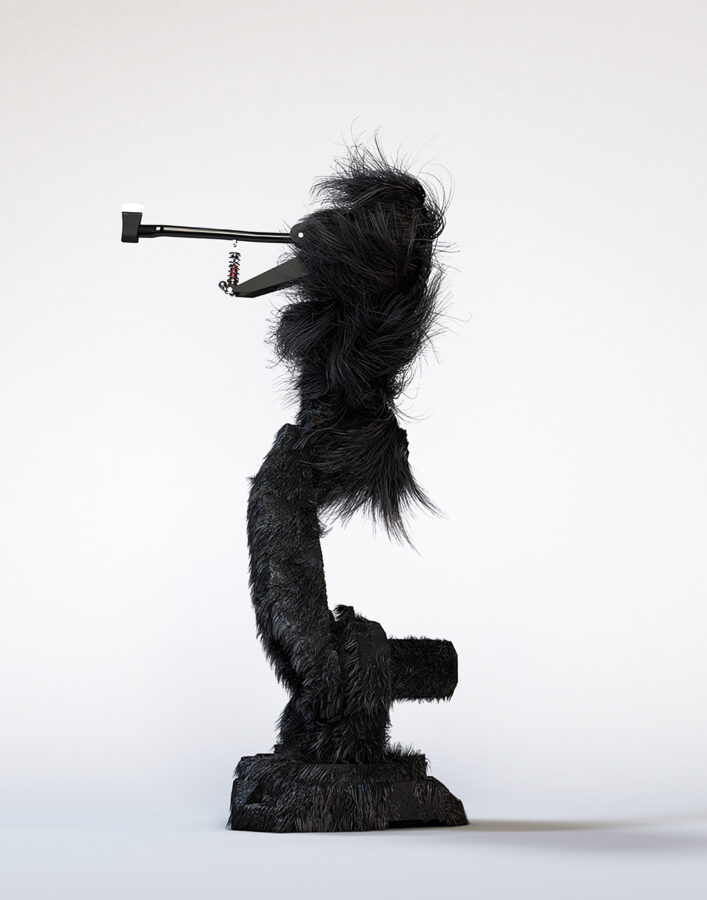
‘Terminal Beach’, 2020, Still of computer-animated droid with the motion sequence of an industrial Kuka robot, Courtesy: Troika
Sabine B. Vogel: What is it about technology that interests you?
Troika: It’s almost impossible today not to be confronted with the effects of technological and scientific advances. They permeate everything – from everyday events and interactions to far-reaching paradigm shifts in how we perceive the world and how those shifts impact the planet.
Early on we became interested in how we construct the world around us. We wanted to explore a range of artistic media, especially those that unfold in time and space – film, sound, light, movement – in order to create alternative versions of reality: phenomenological models, rational models, computational and mathematical models, explanatory and idealised models, even purely imaginary ones.
One of our early works is the installation Electroprobe. At its centre is a magnetic microphone, which we call the Electroprobe. It allows for an almost anthropomorphic encounter with the machines that surround us. For the installation we arranged electronic devices, cameras, laptops, screens, clocks and similar objects. As soon as the mechanised microphone glides over them,
you hear the uncanny hum, mutter and whistle of a soundscape that normally goes unnoticed – like an eerie internal dialogue between apparently living objects.
Recently we were invited to an online exhibition and asked to contribute a still life that reflects our current experience of lockdown. We chose Still Life with Timer (2010), a photograph of the Electroprobe installation. As a stand-alone still life, the work has become oddly relevant to the COVID-19 era: the solitude of the moment, the palpable presence of all these electronic devices and communication tools that now constitute our reality. Late at night, when all the Zoom friends have left the chat, you sit there wondering what comes next, what really matters, and you long to belong somewhere. At some point people try to cling to some semblance of normality.
*
You operate at the boundary of art and technology. Do you have a corresponding training or background?
Over the years we’ve learned how to play with science and technology and how to intervene in them, and we share a fascination for how nature and matter work, and for their underlying wonders. Formal education is secondary to that. Sebastien originally began studying engineering, while Eva studied moving image and Conny photography, before all three of us completed our degrees at the Royal College of Art in London. And we often work closely with biologists, neuroscientists and zoologists.
*
Are you more interested in machines and apparatuses themselves, or in processes?
As artists we’re interested in the transformations technology brings about, and in how these transformations continuously reshape our concepts of space, time and culture. The social and cultural shifts enabled by technological change are immense – most obviously with the rise of digital culture. What concerns us is how our mode of immersion in technology has changed, how art can reflect these profound shifts, and which formal possibilities analogue and digital, high and low technologies open up.

Art Basel Unlimited, Installation View, 2014, Photo: Simon Zachary Chetrit
’Dark Matter’, 2014
Wood, aluminium, black flock,
2.38 x 2.38 x 2.38 cm,
in Art Basel Unlimited, 2014
Photo: Simon Zachary Chetrit
*
How did you arrive at the sculpture Dark Matter?
There are many ways of pursuing our questions about technological progress and about the effects of an excessively rationalised society. Technologies have allowed us to animate and ultimately transform objects, spaces, and our perception of them. But we’re also interested in other media and approaches, as in Dark Matter: depending on where you stand, a large black object hanging from the ceiling appears as a flat square, a hexagon or a circle. It is at once sculpture, performance, immersive experience and flat painting, and ultimately it aims to question whether a subjective standpoint and an objective truth can ever be reconciled.
*
So technology is just one material among others?
Whenever we use technology, it is always as a material carrying its own meanings within a specific context. That also applies to other works – for example when we use dice, which we chose because of their conceptual affinity with computer algorithms. We don’t want to confine ourselves to what is traditionally labelled “technology”. Bringing other, symbolically resonant materials into the work expands what we can explore and experiment with. Our practice is not driven by technology as a medium and by whatever is currently technically possible; it is driven by the impact technology has on how we see and understand the world.
*
Artists who are interested in technology are often placed in a lineage that runs back to Leonardo da Vinci. Would you agree with that?
It’s a questionable comparison. Leonardo da Vinci was a brilliant and prolific inventor, and someone who showed deep respect for people, nature and the environment. Figures like da Vinci are very rare. What is genuinely interesting about him is the idea of the polymath.
As early as the beginning of the 20th century, Max Weber, in his lecture Science as a Vocation, warned of the dangers of disembodied knowledge in a scientific society that amasses endless facts without being able to put them into practice. His example at the time was the tram: even if we know in theory how a tram works, we are still not able to build or repair one – except for a very small group of specialists. That stands in sharp contrast to how knowledge functioned in the previous century: it may have been scarcer, but it was far more applicable in everyday life.
Today the logic of specialisation has been pushed to its extreme. That is why we argue for embodied knowledge. This comes very close to the polymathic ideal, and Leonardo’s life’s work is a constant realisation of that approach. For us, this means not shying away from entering new fields and insisting that our work remains physical. To borrow Robert Heinlein’s phrase:
“Specialisation is for insects.”
*